
How LESCO Manages Peak Hour Surcharges to Balance Grid Load & Revenue
As electricity demand surges across urban Pakistan, especially during hot summer months, the Lahore Electric Supply Company (LESCO) has intensified efforts to manage peak hour electricity usage through a structured Time of Use (ToU) surcharge model. Lesco peak hour surcharges not only regulates grid pressure during high-demand hours but also plays a crucial role in tariff planning and consumer behavior alignment.
What Are LESCO Peak Hour Surcharges?
Peak hour surcharges are additional charges per unit of electricity consumed during predefined high-demand hours — typically when the grid is under the greatest stress.
For LESCO, these surcharges are applied under the Time of Use (ToU) tariff system, which divides the day into:
- Peak Hours (High-cost, high-demand periods)
- Off-Peak Hours (Low-cost, low-demand periods)
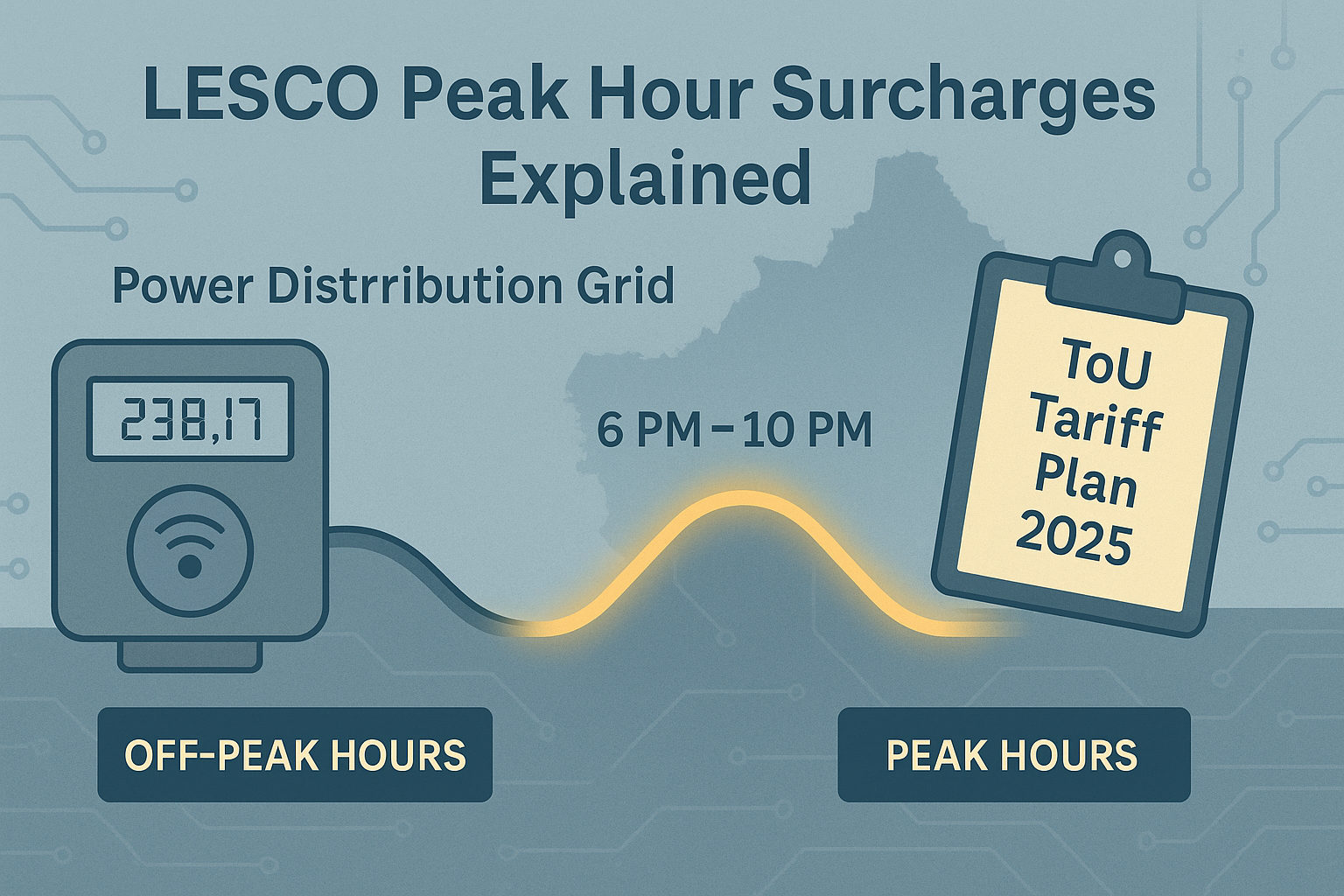
Example: Peak hours in LESCO areas typically range between 6 PM and 10 PM, though this may vary seasonally.
How Does LESCO Calculate Peak Hour Charges?
LESCO follows guidelines issued by NEPRA and adapts ToU models based on regional load patterns, transformer-level feedback, and seasonal grid loads.
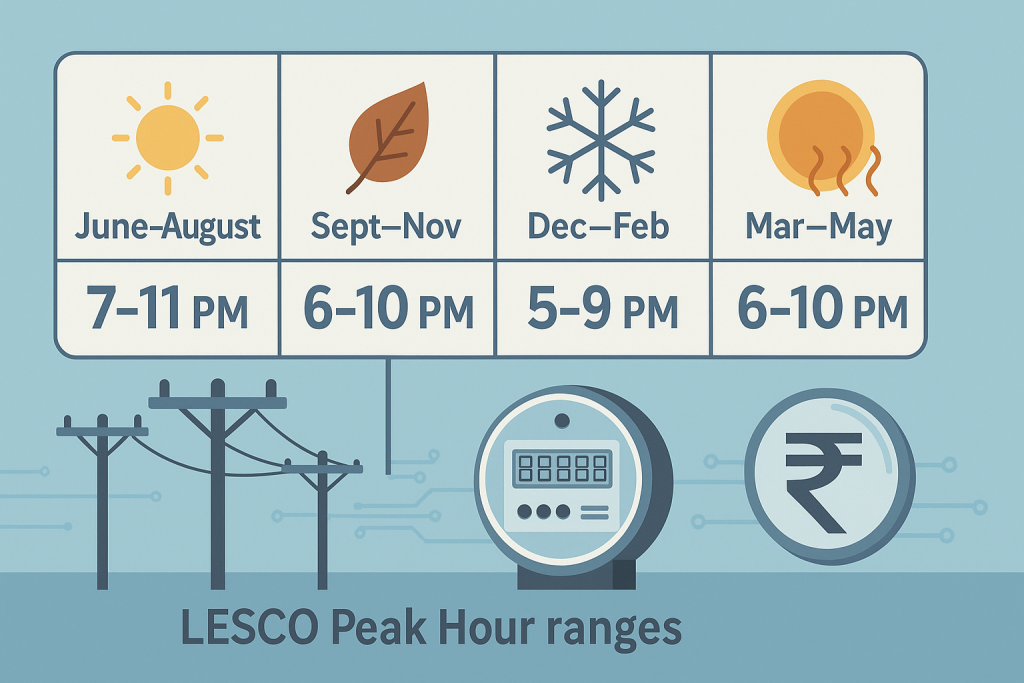
Seasonal Peak vs Off-Peak Electricity Rates by LESCO (2025)
| Season | Peak Hours | Off-Peak Hours |
|---|---|---|
| June – August | 7 PM – 11 PM | 11 PM – 7 PM (next day) |
| September – November | 6 PM – 10 PM | Remaining hours |
| December – February | 5 PM – 9 PM | Remaining hours |
| March – May | 6 PM – 10 PM | Remaining hours |
Key Factors in Surcharge Calculation:
- Load Curve Data from feeders across LESCO zones
- Seasonal Demand Trends (e.g., summer AC load vs winter heating)
- Transmission Constraints and localized transformer limits
- Real-time frequency dips recorded during peak congestion
NEPRA allows a variable surcharge rate (usually Rs. 3 to Rs. 6 per unit above base tariff) depending on demand intensity and policy period.
Impact on Domestic Consumers
Consumers with ToU-enabled digital meters see separate peak and off-peak readings on their LESCO electricity bills. These smart meters automatically log time-based usage, allowing LESCO to apply the correct rate.
LESCO also offers awareness campaigns for domestic users, advising them to avoid running heavy appliances (e.g., washing machines, irons, water pumps) during peak hours.
Learn how to read your LESCO online bill and identify peak hour consumption segments.
Industrial & Commercial Users
LESCO enforces peak-hour management more stringently for industrial and large commercial units. These consumers often face:
- Penalty surcharges for load violations during peak
- Mandatory load curtailment notices
- Time-bound load balancing obligations to prevent feeder trips
Smart industrial clients often use energy automation systems to shift load schedules to off-peak hours and avoid peak surcharges.
Grid Balancing & Revenue Recovery
Peak surcharges are not just a pricing tool — they are part of LESCO’s broader load management strategy:
- Grid Balancing: Encourages users to avoid overloading the system during fragile hours
- Cost Recovery: Reflects the higher cost of electricity procurement during peak hours
- Behavioral Control: Creates economic signals that drive load shifting
What Happens Next: Localizing Peak Hours
NEPRA has recently directed all Discos, including LESCO, to review and localize peak/off-peak hours based on regional patterns. A revised ToU model may emerge by the end of 2025 that:
- Adjusts timing per service zone
- Introduces seasonal ToU blocks
- Differentiates rural vs. urban ToU surcharges
How to Reduce Peak Hour Charges?
To minimize your LESCO electricity bill during peak hours:
- Use heavy appliances early morning or late night
- Install timers on air conditioners and water pumps
- Check if your meter supports ToU segmentation
- Consider shifting to net metering to offset peak hour usage with solar generation
Final Thoughts
LESCO peak hour surcharges strategy is a critical lever in both grid stability and financial sustainability. While it adds cost pressure for certain consumers, it also fosters smarter energy habits, load distribution, and long-term system resilience.
As the national conversation around tariffs, net metering, and microgrids continues, LESCO’s localized peak hour model could serve as a blueprint for dynamic energy pricing across Pakistan.
FAQs
What time are LESCO peak hours?
Peak hours typically fall between 6 PM and 10 PM, but may vary seasonally and by zone.
Can domestic users avoid peak surcharges?
Yes. Avoid heavy appliance use during peak times and shift usage to off-peak hours.
Do smart meters help with ToU billing?
Absolutely. Smart meters allow LESCO to track and apply accurate peak/off-peak rates.
How is peak hour surcharge calculated?
It’s based on grid load, demand, and NEPRA’s tariff policy. Rates may vary by zone and time.
Will LESCO’s peak hours change in 2025?
Likely yes. NEPRA has directed all Discos to localize ToU timings to better reflect regional usage.